


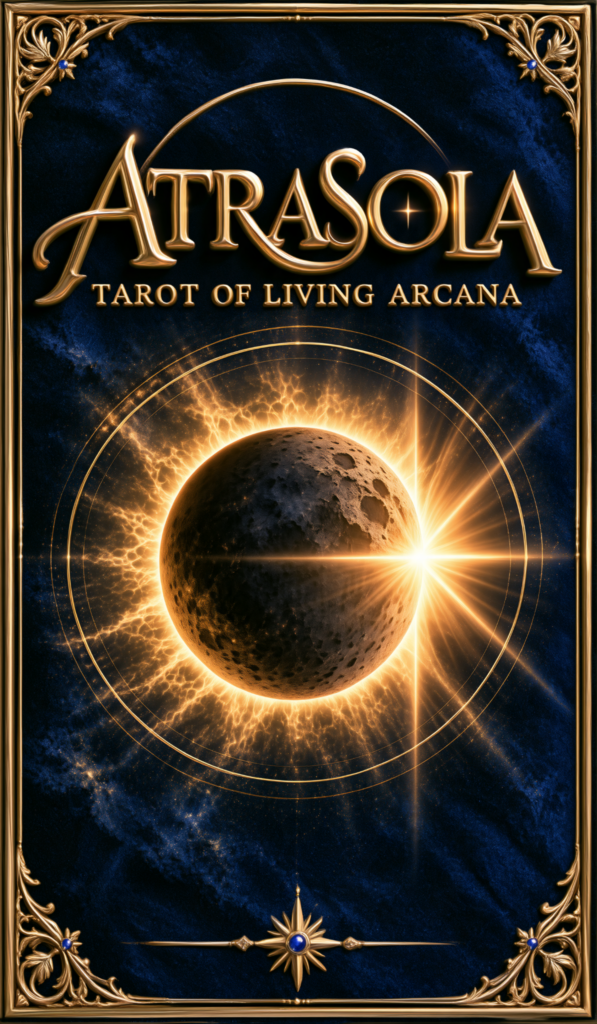
The Soul of the Arcana Method, Based on the Original AtraSola — Tarot of the Living Arcana Deck
In the previous chapter, I told you how AtraSola came to life and why I decided to develop my own method. Now it’s time to put it into practice.
How can you read tarot intuitively, without constantly reaching for a guidebook or struggling to remember meanings you’ve learned by heart? The first step in learning how to connect with your tarot deck is to listen to yourself, feel the energy of the Arcana, and establish a living connection with the cards.
Before getting to know the Arcana themselves, it’s important to learn how to enter a state in which you can do more than simply look at the pictures. The idea is to learn to feel the cards, rather than just observe their images.
And you don’t need to surround yourself with magical objects, memorize rituals, or follow rules someone came up with long ago.
It’s much simpler than that. And, at the same time, much deeper.
Forget the Rigid Rules
The internet is full of advice about the “proper” way to handle tarot cards.
You must keep your deck in a wooden box. Or a silk pouch. Never leave it on your bed. Never let anyone else touch it. Always cut the deck with your left hand. Shuffle exactly seven times.
And before you know it, instead of getting to know tarot, you’re afraid of doing something wrong.
Tarot won’t stop speaking to you just because you put your deck in the wrong box.
I keep the decks I work with in simple little pouches. Sometimes they’re on a shelf, sometimes on my desk, sometimes on my bed. I pick them up when I’m ready to work, without making a ceremony out of it.
For me, what matters isn’t where I keep my cards, but the state I’m in when I pick them up.
Over time, every tarot practitioner develops their own habits. That’s perfectly natural. But one person’s habits shouldn’t become rules that everyone else is expected to follow.
When You Shouldn’t Work with Tarot
Now, this is where I do believe there are rules.
Don’t work with tarot when you’re overwhelmed by anger, aggression, intense fear, or despair.
Imagine you’ve just had an argument with someone you love. You’re hurt and furious. You grab your deck and start asking what they’re feeling, whether they’re cheating on you, or whether they’ll come back.
But you’re so consumed by your own emotions that it’s impossible to hear anything else. You’ll start seeing confirmation of your fears in every card.
In that state, the cards won’t work properly. Instead of perceiving their messages calmly, you’ll find yourself looking at a reflection of your own emotional turmoil.
The first thing you need to learn is not to reach for your deck in the middle of an emotional storm.
Put the cards aside until the tension inside you begins to ease. You don’t have to force yourself to calm down immediately. Just give it some time.
All you need is to regain your usual inner balance, that point where your emotions are no longer in control of you.
Create an Atmosphere Where You Feel Comfortable
There’s no need to turn your room into a magical temple. Choose somewhere you feel comfortable and won’t be disturbed.
Some people like working at a table. Others prefer an armchair or a sofa. There’s no single correct way to sit.
You might enjoy playing soft meditation music or sounds from nature: rustling leaves, gentle rain, or the quiet flow of water. The important thing is that the sounds remain in the background rather than taking up all your attention.
Personally, I like to light a candle.
Not because the cards would refuse to work without one. There’s something calming about watching a candle flame. As it burns steadily, my thoughts begin to slow down and my attention stops jumping from one thing to another.
But if you feel happier working in daylight, in complete silence, without a single candle, that’s wonderful too.
Your goal isn’t to perform a ritual. It’s to create an atmosphere in which you can hear yourself more clearly.
Your First Practice: A Few Minutes of Silence
Before picking up your deck, try this simple exercise.
Make yourself comfortable. Relax your shoulders, arms, and facial muscles. Close your eyes if that feels right for you.
Take a few gentle breaths. There’s no need to control your breathing or try to reach some extraordinary state of consciousness. Just notice the tension beginning to leave your body.
Imagine that all your daily responsibilities, conversations, and unresolved problems have been set aside.
They haven’t disappeared. You simply don’t need to deal with them right now.
Thoughts will still come into your mind. Don’t try to stop them. Let them arrive and pass on their own. There’s no need to argue with them, analyze them, or criticize yourself for having them.
Stay like this for two or three minutes.
Gradually, you’ll begin to notice the difference between your usual state, when one thought constantly follows another, and that inner stillness in which listening to yourself becomes so much easier.
This is your first step toward the meditative immersion we’ll use in the Soul of the Arcana method.
Getting to Know Your Deck Through Touch
Now take your cards into your hands.
Don’t rush to shuffle them.
Simply hold the deck for a while. Feel its weight, the texture of the cards, and the way they rest against your palms. Run your fingers along the edges and move the deck gently from one hand to the other.
Close your eyes and pay attention to what you feel.
Perhaps you’ll notice warmth. Or a sense of peace. You might feel like keeping the deck between your palms for a few more moments.
Or perhaps you won’t notice anything unusual at all.
That’s perfectly normal.
Don’t expect yourself to feel energy immediately. There’s no need to try to produce warmth or tingling sensations just because you think they should be there.
We’re learning to develop our sensitivity, not to invent sensations we haven’t experienced.
As time goes by, your connection with the deck will become more natural and profound.
And one day, you may notice that simply touching your cards is enough to help you shift into the right state of mind for working with them.
How to Develop Tarot Intuition: Don’t Dismiss What Comes Naturally
We’re so accustomed to explaining everything and keeping our minds in control that we often fail to notice our own intuition.
Sometimes a thought appears out of nowhere, without any obvious reason.
You haven’t had time to analyze anything, yet a feeling, an image, or a sudden insight has already appeared within you.
Don’t dismiss it simply because you can’t explain where it came from.
In esoteric practice, guidance from the subtle world often comes to us in precisely this way: through unexpected thoughts, images, memories, and sensations that seem to arise all by themselves.
Learn to listen to yourself.
At the same time, don’t turn every passing thought into some great revelation.
Simply notice what comes naturally. Don’t rush to judge it, reject it, or explain it away.
Intuition doesn’t like being interrupted by ready-made answers. Give it a chance to speak.
Why I’m Creating My Own Tarot Deck, AtraSola
It’s precisely to encourage this direct connection with the Arcana that I’m creating my own original deck, AtraSola — Tarot of the Living Arcana.
Many traditional tarot decks are filled with stylized images, complicated symbols, and abstract elements.
For beginners, it can take a great deal of time to work out what all those symbols mean before they can begin to feel the Arcana themselves.
With AtraSola, I’ve chosen a different approach.
Each Arcanum is a living image, with realistic faces, expressive eyes, recognizable emotions, and natural movements.
Light, color, and the surrounding environment all play their part. Every detail helps you sense the character of the card.
The image itself becomes a clue.
You don’t have to struggle to remember what a particular symbol means.
You look at the card, immerse yourself in the scene unfolding before you, and begin to feel its energy.
I create every Arcanum with love and close attention to even the smallest details.
And I’m not doing it simply to make beautiful pictures.
AtraSola is a practical tool that I’m developing specifically for the Soul of the Arcana method. Its purpose is to make working with tarot more natural and harmonious, without having to memorize meanings or study endless esoteric symbols and terminology.
The deck is designed to help you enter the energetic space of each Arcanum more easily, connect with its archetype, and develop your intuitive and extrasensory perception.
I want the living image itself to guide you toward understanding, so you don’t have to keep reaching for a guidebook every time you look at a card.
That’s the idea behind AtraSola:
Not to make you memorize tarot meanings, but to give you the opportunity to feel and understand each Arcanum through its living image.
How to Shuffle Tarot Cards and Know When to Stop
You’ve taken some time to relax, quiet your thoughts, and hold your deck in your hands.
Now you’re ready to begin.
Start shuffling in whatever way feels most comfortable to you.
As you shuffle, silently ask the question you’d like the cards to answer.
There’s no need to come up with long, complicated wording. Just be clear about what you want to know.
For example:
“What do I need to understand about this situation?”
Or:
“What’s happening between this person and me right now?”
Keep shuffling while focusing your attention on the question.
Don’t count your movements. Don’t worry about whether you’ve shuffled exactly seven or nine times.
Listen to yourself.
At some point, you may feel as though your hands simply want to stop.
That’s when you stop.
There’s no reason to carry on shuffling just because a book somewhere told you to do it a certain number of times.
With practice, you’ll become more aware of that natural moment when something inside you says, “That’s enough.”
How to Draw Your Cards
Here’s another question that often leaves beginners feeling uncertain.
Should you cut the deck first? Which hand should you use? Should you spread the cards into a fan? Should you lay them face down or turn them over immediately?
My answer is simple:
Try different methods and find the one that feels right for you.
Personally, once I’ve finished shuffling, I simply draw my cards from the deck and turn them face up straight away.
I like seeing the Arcanum immediately and sensing its mood.
But that’s my way of doing things.
You might prefer to spread the cards face down in a fan and choose whichever one your hand feels drawn toward.
Or you could place several cards face down on the table and turn them over one by one.
Some people like cutting the deck. Others don’t feel any need to.
Try one method a few times, then another.
Pay attention to which one makes you feel more comfortable and allows your movements to become natural and effortless.
There’s no single technique that everyone must follow.
You’re learning to communicate with the cards, not taking an exam in shuffling techniques.
What Beginners Should Avoid
Certain habits can get in the way of developing your intuitive perception.
The first is constantly being afraid of making a mistake.
You haven’t even drawn a card yet, and you’re already worrying about whether you’re holding the deck correctly or breaking some rule. That kind of tension only makes things harder.
The second is expecting extraordinary sensations straight away.
Don’t assume that the moment you touch your deck, you’ll feel energy rushing through your hands, begin seeing visions, or hear the Arcana speaking aloud. Sensitivity develops gradually.
The third is wanting only pleasant answers.
When you ask a question, you need to be willing to hear more than just what you want to hear. Don’t keep reshuffling the deck over and over in the hope of getting a more appealing card.
The fourth is constantly doubting your own impressions.
You look at an Arcanum, sense its atmosphere, and notice a thought forming in your mind. But then uncertainty takes over. You open a guidebook and immediately decide that what you felt must have been wrong.
Don’t be so quick to dismiss your own experience.
Traditional meanings matter, and we’ll be working with them. But right now, we’re learning how to establish a living connection with the cards.
First, allow yourself to feel the card, observe its details, and understand what it tells you. Only then compare your impressions with traditional meanings.
This is how genuine understanding of tarot begins to develop, rather than mechanical memorization.
Your First Tarot Exercise
Now let’s bring everything you’ve learned together in one practical exercise, from preparing yourself inwardly to meeting your first Arcanum.
Set aside ten to fifteen minutes when you know you won’t be disturbed.
If you like, light a candle or play some gentle sounds of nature. Make yourself comfortable, sit quietly for a moment, and relax.
Take your deck into your hands. Don’t rush. Feel the cards against your palms.
Ask a simple question:
“What is important for me to understand today?”
Begin shuffling calmly. Don’t count how many times you shuffle, and don’t try to guess which card is supposed to appear.
When you feel you’ve shuffled enough, stop.
Draw one card in whatever way feels most natural to you.
Look at it.
Don’t open your guidebook just yet. Don’t try to remember everything you’ve ever learned about its meaning.
Simply study the image.
What kind of atmosphere surrounds the scene? What emotions does it stir in you? What was the very first thing that caught your attention?
Perhaps it’s a character’s face, their posture, a movement, or a particular color. Maybe it’s a small object you wouldn’t normally notice.
Or perhaps, as you look at the card, a thought suddenly comes into your mind that seems completely unrelated to what you expected to see.
Don’t push it away.
Spend a few minutes with the card. Try to feel what it’s saying to you personally and why it appeared in response to your question.
You don’t need to reach a final conclusion immediately.
Right now, what’s important is the experience of getting to know the card.
After the exercise, you can write down your first impressions, even if they’re just a few words that came to you spontaneously.
Later, you may find it fascinating to look back at those notes and see how your perception has changed.
Everyone Has Their Own Path to the Soul of the Arcana
Every tarot reader has a world of their own.
Each practitioner has their own personality, energy, life experience, and individual perception of the subtle world.
Some people connect with the cards most strongly through their imagery. Others feel them through emotions. Some notice energetic sensations or receive sudden intuitive guidance.
That’s why two experienced tarot readers can describe the very same Arcanum in completely different ways.
You don’t need to become an exact copy of your teacher.
Learn, observe, experiment, and listen to yourself.
Gradually, you’ll discover your own way of communicating with the cards.
Our aim isn’t to abandon traditional knowledge, but to learn to understand it on a deeper level.
It’s not simply about remembering what a symbol means. It’s about feeling why that symbol has appeared in this particular place and what it wants to tell us.
This is the foundation of the Soul of the Arcana method.
Today, we’ve taken our first step. We’ve learned how to create a calm inner state, pay attention to our intuition, and approach the deck without worrying about breaking someone else’s rules.
In the next chapter, we’ll begin getting to know the Arcana themselves: their personalities, moods, energies, and the stories they have to tell.
You can only understand the soul of an Arcanum when you stop being afraid to hear its own voice.
Oksana SOUL
Creator of the Soul of the Arcana method and the AtraSola — Tarot of the Living Arcana deck.
→ Contact
→ AtraSola — The Living Arcana Tarot
→ How to Read Tarot Without Memorizing Card Meanings: The Art of Connecting with the Cards
→ The Fool Tarot Card Meaning (0) — The First Step into the Unknown