


Discovering the Soul of the Arcana
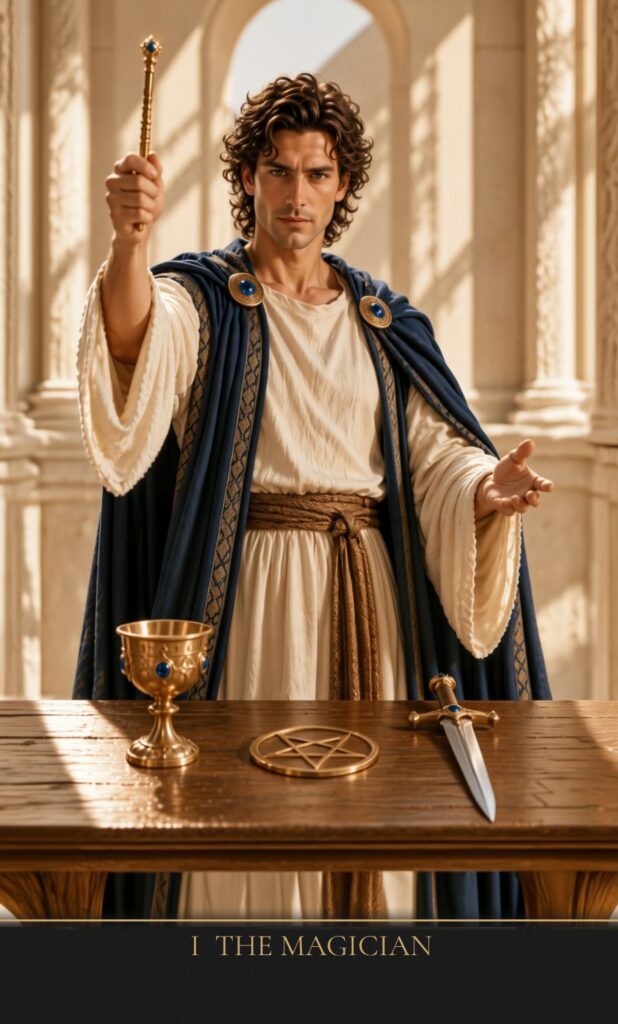
The Magician Tarot card is the first numbered card of the Major Arcana. Today, we’re going to discover its meaning without memorizing endless lists of interpretations. All we need to do is look at the image, understand its symbols, and get to know the character standing before us.
Remember the Fool from the AtraSola deck?
That carefree young man setting off into the unknown, with absolutely no idea what lay ahead?
Today, we’re meeting someone very different.
The Magician — card number one of the Major Arcana.
A confident man with a steady, penetrating gaze. In one hand, he holds a wand raised high; the other is extended toward us, palm open.
Take a look at the table.
There’s a cup, a sword, and a pentacle. Together with the wand in his hand, they represent the four elements — Water, Air, Earth, and Fire — associated with the four Tarot suits: Cups, Swords, Pentacles, and Wands.
Water represents feelings and emotions. Air governs the mind and thoughts. Earth belongs to the material world. And Fire represents willpower, energy, and action.
Our Magician has all four elements at his disposal.
What does that tell us about his personality?
For a start, he has the knowledge, abilities, and tools he needs to achieve his goals. He knows how to work with different forces and understands when and how to use each one.
He certainly doesn’t look like someone who sits around waiting for circumstances to turn in his favor.
He would rather create those circumstances himself.
But there’s another important piece of the puzzle.
Why is the Magician numbered one?
In numerology, the number one represents individuality, the ego, independence, and personal will.
People strongly influenced by the number one usually know exactly what they want. Their own desires, interests, and ambitions come first.
They are individualists, often selfish, accustomed to making their own decisions and reluctant to submit to anyone else’s will.
Now connect those qualities with what we’ve already seen in the image.
Here stands a man who knows what he wants, has the necessary tools, and knows exactly how to use them.
That combination gives him tremendous power to influence others.
He can persuade, inspire, and find a way to approach all kinds of people. He knows when to be firm, when to appeal to someone’s emotions, and when to rely on cold logic.
And he can also become a brilliant manipulator.
Because when achieving your own goal matters more than anything else, how much consideration are you prepared to give to other people’s interests?
One Magician uses his abilities to create and help. Another uses exactly the same skills to control people for his own benefit.
And both may be true masters of their craft.
The difference lies in their intentions and the methods they choose.
For the Magician, achieving his personal goal can sometimes matter more than the means he uses to get there.
At his best, he can create extraordinary things, transform circumstances, and find solutions where others see nothing but obstacles.
But when selfishness takes over, he may stop caring about other people’s feelings and interests.
And that’s when we encounter a dangerous manipulator.
So the Magician isn’t necessarily a positive character.
His power alone doesn’t make him good or bad. Everything depends on how he chooses to use it.
Three qualities define the Magician:
Willpower. Mastery. Influence.
And the number one reminds us of something essential: at the center of the Magician’s world are his own ego and ambitions.
Imagine someone like this entering your life.
He might be an extraordinary professional, an excellent manager, a determined admirer, or an exceptionally skilled con artist.
How do we know who we’re dealing with?
That’s where the questions we ask the cards become so important.
Let’s explore a few everyday stories and see how the Magician reveals himself in different situations.
This is exactly why I’m creating my own deck, AtraSola — Living Arcana Tarot.
I want every card to be a work of art, but I also want its imagery to tell its own story. You should be able to look at a character, discover their personality, recognize their intentions, and understand the meaning of the card without having to memorize long lists of interpretations.
The Magician in Love and Relationships
A Man Who Knows How to Win a Woman Over
A woman has recently met a man.
He’s interesting, confident, and knows how to charm her. He calls, suggests dates, and arranges little surprises.
There’s never a dull moment with him.
He also seems remarkably good at reading her mood. He knows when to make a joke, when to offer a compliment, and when to simply listen.
She turns to the cards and asks:
“How will this man behave toward me over the next month?”
The Magician appears.
What do we already know about his character?
He’s confident, takes the initiative, and knows how to make the most of his opportunities.
So there’s a good chance he’ll continue showing interest, arranging dates, and looking for ways to get closer to her.
He might plan a wonderful evening, find exactly the right words, and leave an unforgettable impression.
Here, the Magician represents a man who knows how to pursue someone he desires.
But let’s not jump to conclusions.
We asked about his behavior, not his feelings.
A man can be a skilled seducer without being in love or having the slightest intention of getting married.
Remember the number one.
What matters to the Magician is getting what he wants.
What we don’t yet know is exactly what he wants from this relationship.
So let’s ask another question:
“What are his true intentions toward this woman?”
Suppose we draw the Two of Cups.
Now we have reason to consider genuine affection, emotional interest, and a desire for a mutual connection.
But what if the Five of Swords appears?
The picture changes considerably.
He may see the relationship as a competition he needs to win. Perhaps proving his superiority or getting what he wants matters more to him than the woman’s feelings.
In both situations, the Magician remains the same.
Intelligent, confident, and determined.
But in the second case, his abilities may be serving purely selfish interests.
When Love Becomes a Form of Control
Here’s another story.
A woman has been dating a man for several months.
He’s charming, attentive, and knows how to talk about love.
But gradually, she begins to notice something strange.
Whenever she wants to spend time with her friends, he gets offended.
If she disagrees with him, he manages to twist the conversation so skillfully that she ends up feeling guilty.
She tries to explain what she wants, but somehow they always end up discussing what he wants instead.
And the curious thing is that he hardly ever raises his voice.
He speaks calmly, offers convincing arguments, and chooses his words so carefully that she begins to doubt her own judgment.
One day, she asks the Tarot:
“How is this man influencing me within our relationship?”
The Magician appears.
Now his ability to use different tools takes on a very different meaning.
Remember the four elements.
Water: feelings.
Air: thoughts.
Fire: willpower.
And what if someone knows exactly how to influence another person’s emotions, direct their thoughts, and bend their will?
We may be dealing with someone who has mastered the art of emotional and psychological influence.
He knows when to be affectionate, when to make someone feel guilty, when to persuade, and when to insist.
All to achieve his own goal.
In a reading like this, the Magician may point to manipulation, a desire to control a partner, and a tendency to place personal interests above the other person’s needs.
The wording of the question makes all the difference.
If the woman had asked:
“What qualities does my partner have?”
We might have spoken about intelligence, confidence, initiative, and the ability to influence people.
But she specifically asked how he influences her.
And now we’re seeing a completely different side of his abilities.
One card alone doesn’t prove that the man intends to hurt her. It does, however, reveal a possible pattern of influence and help us decide what to investigate next.
What If the Woman Wants Him Back?
After an argument, a man stops speaking to his partner.
She’s worried, constantly checking her phone and hoping for a message.
A week goes by. Then another.
Nothing changes.
Finally, she asks:
“What can I do to change the situation between us?”
The Magician appears.
This time, the card isn’t describing the man.
It’s showing the woman her own possibilities.
She has intelligence, emotions, willpower, and the ability to act.
Perhaps, instead of waiting indefinitely, she could suggest a conversation, try to understand what caused the conflict, and calmly explain her own position.
But there’s an important distinction here.
The Magician is an individualist.
So his appearance may also warn against trying to achieve reconciliation at any cost.
If the woman isn’t interested in understanding what happened but simply wants to force the man to return, she’s beginning to display the darker side of the Magician herself.
There’s a world of difference between taking the initiative and manipulating someone.
And the Magician can represent either one.
The Magician at Work and in Professional Life
When Someone Truly Knows Their Craft
A man has spent many years working in his profession.
He’s an excellent specialist. Whenever a difficult problem comes up, his colleagues turn to him because they know he’ll find a solution.
Recently, a management position has become available at the company.
He wants the promotion and asks:
“Which of my personal qualities will help me get this position?”
The Magician appears.
The answer is practically right in front of us.
Our character has all the necessary tools and knows how to use them.
In professional matters, the Magician can represent experience, knowledge, resourcefulness, organizational skills, and the ability to make decisions.
But there’s something else.
He doesn’t hide his abilities or hesitate to demonstrate what he can do.
And perhaps that’s exactly what the man in our story has been missing.
He’s used to doing his job well, but he rarely talks about his achievements.
He assumes management should notice his efforts without being told.
The Magician reminds him that being good at something isn’t always enough. You also need to show people what you’re capable of.
Take the initiative. Present your results. Put forward your ideas.
Knowledge becomes truly useful when you know how to apply it to a specific goal.
In questions about career development, the Magician often reveals someone who already possesses important abilities for achieving success.
But having the potential to succeed and actually getting the position are two different things.
If we want to explore the likely outcome, we need another question:
“What are my chances of getting promoted within the next three months?”
And then we draw an additional card.
The Colleague Who Always Knows How to Impress the Boss
Two specialists work at the same company.
The first does his job responsibly, helps his colleagues, and takes on difficult assignments.
The second is also competent.
But he has another talent.
He knows exactly how to handle his superiors.
He always manages to find the right moment to speak to the boss, present his results, and draw attention to his achievements.
And every now and then, he takes credit for some of his colleagues’ work as well.
The first employee notices that the most interesting projects and the best opportunities increasingly go to this colleague.
He decides to ask:
“What strategy is my colleague using to advance his career?”
The Magician appears.
Once again, we’re dealing with someone who knows how to use his tools.
But this time, his ability to influence others stands out.
He knows what to say, whom to approach, when to take the initiative, and how to present his work in the most favorable light.
And if his own ambitions matter more to him than anyone else’s interests, he may even use other people’s achievements to get ahead.
In this situation, the Magician may represent an exceptional talent for self-promotion, influencing management, and shaping the opinions of people who make important decisions.
But there’s a crucial difference.
Knowing how to communicate and stand out professionally doesn’t automatically make someone dishonest.
If a person is competent and knows how to present their achievements, we’re seeing one of the Magician’s positive qualities.
If he lies, takes credit for someone else’s work, and uses his colleagues for personal gain, we’re seeing his darker side.
To distinguish between the two, we need to consider the facts of the situation and the cards surrounding the Magician.
The Magician and Money: Who Is Really in Control?
A woman receives an offer to invest her savings in a promising business.
The opportunity sounds fantastic.
The businessman speaks confidently, presents attractive figures, and shows examples of deals that, according to him, have been highly successful.
He’s so convincing that she’s almost ready to sign the contract.
But first, she decides to consult the Tarot:
“What danger might I be overlooking in this offer?”
The Magician appears.
Let’s remember his character.
This is someone who knows how to get what he wants.
He’s skilled at persuasion and understands how to influence other people’s thoughts and emotions.
When we ask about potential danger, those abilities may take on a very different meaning.
Perhaps the businessman genuinely knows his industry inside out.
But it’s also possible that his greatest talent lies in making an offer sound irresistible.
He knows which figures to show, which advantages to emphasize, and which difficulties are best left in the background.
The Magician may warn us about someone who skillfully shapes our perception of a situation for personal gain.
That doesn’t mean we’ve uncovered a fraud.
The card is pointing toward a possible risk of manipulation.
The woman therefore needs to separate the business’s genuine potential from the impression created by the person presenting it.
Check the figures, examine the documents, and understand the terms of the agreement.
Only then should she make her decision.
Now let’s change the situation.
This time, the woman wants to open a small shop of her own.
She asks:
“What will help me manage the money I have available?”
And once again, the Magician appears.
But now he reveals a completely different set of qualities.
Planning, initiative, decision-making, and the ability to make effective use of available resources.
In the first situation, we saw the danger of someone else’s influence.
In the second, we saw a person’s ability to manage her own material resources.
The same card.
Two different questions.
Two different interpretations.
What Does the Magician Mean in Magical Practice?
Here we return to the very nature of his image.
It’s no coincidence that the Magician holds a wand and has the symbols of the four elements laid out before him.
He knows the forces he works with and understands how to direct them.
In magical tradition, he represents someone who possesses knowledge, the ability to focus their will, and the skill to work with energies.
But simply having all four symbols in front of you doesn’t make you a true master.
That requires an understanding of each element’s nature, knowledge of its correspondences, and the ability to apply its forces correctly.
Consider someone who has only recently begun studying magic.
They learn about rituals, magical tools, and different ways of working with the elements.
Their knowledge keeps growing, but they never quite dare to begin practicing independently.
They always feel they aren’t ready yet.
So they ask:
“What will help me develop my magical abilities?”
The Magician appears.
In this context, the card speaks particularly clearly.
It points to the need to bring knowledge, willpower, and practical experience together.
Collecting information about rituals and magical instruments isn’t enough.
You need to understand what they are for, learn how to work with them, and develop command of your own abilities.
Now consider someone with experience.
A person who already knows how to work with energies, understands certain magical practices, and is aware of their own power of influence.
They ask:
“What danger should I be aware of in my magical work?”
And they receive the Magician.
Remember his number: one.
My will.
My desire.
My goal.
But what happens when someone begins to believe they have the right to interfere in other people’s lives simply because they possess the knowledge to do so?
That’s when the darker side of the Magician emerges.
Willpower becomes a desire to dominate.
Mastery becomes an instrument of control.
And personal interests begin to take precedence over everything else.
The Magician represents both the power of a magical practitioner and the danger of placing that power entirely in the service of selfish desires.
That’s why, when this card appears in a reading concerning magic, understanding the person’s intentions and objectives becomes especially important.
What Can the Magician Tell Us About Health?
In health-related questions, the Magician can reveal very different attitudes.
A man is undergoing long-term treatment.
He’s used to making his own decisions, researching information, asking doctors questions, and trying to understand everything connected with his condition.
He asks:
“What can I do to take a more active role in my recovery?”
The Magician appears.
Here we see someone who doesn’t want to sit back and wait.
He wants to understand what’s happening and make use of the possibilities available to him.
The Magician may represent his ability to follow medical instructions, organize his daily habits, and take an informed, active role in his recovery.
Now consider another man.
He’s equally convinced of his own knowledge.
But he hardly trusts doctors at all.
He constantly reads advice online, chooses medications for himself, changes treatments, and believes he understands his condition better than the specialists.
He asks:
“What mistake might I be making regarding my health?”
And he receives exactly the same card.
Now the Magician’s confidence takes on another meaning.
It may represent excessive trust in one’s own knowledge, a desire for absolute control, and an inability to recognize the limits of one’s expertise.
In the first case, the card showed awareness and the ability to take constructive action.
In the second, it warned against excessive self-reliance and the mistaken belief that one can handle absolutely everything alone.
Of course, a Tarot card cannot establish a diagnosis, determine the severity of an illness, or replace a medical prognosis.
But it can help us explore a person’s attitude toward their circumstances.
Learning to Ask the Magician the Right Questions
Let’s practice a little.
We already know the essential qualities of our character.
He has knowledge and tools, takes action, pursues his goals, and possesses a remarkable ability to influence others.
But which of these qualities will appear in a reading?
That depends on the question we ask.
“What Will Help Me Achieve What I Want?”
Someone has been dreaming of changing their professional life for a long time.
They have knowledge, experience, and valuable skills.
Yet they keep waiting for the perfect moment.
The Magician appears.
Here, the card points to the need to use the opportunities already available.
Take the initiative, demonstrate your abilities, and begin acting independently.
Above all, be clear about your goal.
The Magician acts with purpose because he knows exactly what he wants.
“What Is the Biggest Mistake I Could Make?”
We’re looking at the same person, but the question has changed.
And the Magician appears again.
This time, talking only about initiative wouldn’t answer the question.
The card may warn of overconfidence, overestimating one’s abilities, or difficulty listening to different opinions.
The person may be so focused on their goal that they overlook important circumstances.
Perhaps they believe they can solve every problem without help.
Or perhaps they’re prepared to use other people to achieve their own success.
Here, the number one becomes especially significant.
The ego can turn from a person’s greatest source of strength into their greatest weakness.
“What Is This Person Hoping to Gain by Approaching Me?”
A woman unexpectedly receives a message from her ex-partner.
Then another.
He calls, asks how she’s doing, and suggests they meet.
She wants to understand what’s behind this sudden interest.
The Magician appears.
What does he tell us?
We’re looking at someone who takes the initiative and knows how to act to get what he wants.
He’s probably trying to influence the situation and steer their communication toward the outcome he desires.
But what exactly does he want?
To restart the relationship?
To receive attention?
To become intimate again?
To regain his influence over her?
The Magician alone doesn’t tell us.
He shows someone taking action in pursuit of a personal goal.
So our next question needs to be more precise:
“What is he trying to achieve by reconnecting with me?”
An additional card will help us explore his intentions.
This is why separating questions matters.
The Magician may reveal the man’s initiative, but that doesn’t mean he must simultaneously tell us everything about his feelings, plans, and the future of the relationship.
“How Can I Protect Myself From Someone Else’s Influence?”
A woman works for a boss who constantly pressures his employees.
He’s persuasive, gets people to accept extra responsibilities, and makes them feel guilty whenever they try to say no.
She asks:
“How can I better protect my interests when dealing with this person?”
The Magician appears.
And this time, our character is on her side.
Why?
Because the card is now answering a question about the woman’s own actions.
The Magician points to the importance of intelligence, confidence, understanding the situation, and knowing how to negotiate.
She needs to express her position clearly, understand her own interests, and support her decisions with convincing arguments.
Just because her boss knows how to influence people doesn’t mean she has to submit to that influence.
She can learn to use her own tools, too.
And so the Magician stops representing a potential opponent and becomes an ally.
The same card can describe both a manipulator and someone capable of standing up to manipulation.
That’s why memorizing a handful of keywords for each card isn’t enough.
We need to understand what we’re asking and which aspect of the character is answering our question.
The Magician as a Personality
Suppose you ask:
“What kind of person is this? What’s their character like?”
And the Magician appears.
We may be looking at a fascinating personality.
Someone who knows their abilities and understands how to use them.
They don’t tend to rely on luck.
They prefer to create the circumstances they need.
They’re resourceful, decisive, and full of initiative.
They know how to speak persuasively, organize other people, and find solutions in difficult situations.
But remember that the Magician is numbered one.
And number one doesn’t like taking orders.
Someone with these qualities wants to make their own decisions, establish their own rules, and choose their own direction.
They may become an excellent leader, a successful entrepreneur, or an outstanding master of their craft.
Living with them, however, isn’t always easy.
They may struggle to acknowledge someone else’s superiority, accept restrictions, or give up their own desires.
When selfishness becomes especially pronounced, they may start treating the people around them as tools for achieving personal goals.
And they won’t necessarily be aggressive about it.
A skilled manipulator rarely says:
“You have to do this because I want you to.”
Instead, they create the circumstances that lead another person to make a decision that benefits them.
They choose the right words, stir particular emotions, and find arguments that are difficult to resist.
They may even convince someone that the decision was entirely their own.
That’s how subtle the Magician’s darker side can be.
But we shouldn’t forget his strengths.
The very same person may use those abilities to help others, create wonderful things, and solve extraordinarily difficult problems.
So when the Magician appears as a personality card, recognizing someone’s power is only the beginning.
We also need to understand how that power is being used.
Why Is the Number One So Important to the Magician?
Let’s return to his number.
The Fool carries the number zero.
Zero represents the beginning of an unknown journey, openness to the world, and freedom from familiar restrictions.
Our Fool doesn’t yet know exactly what he wants from life.
He sets off in search of adventure, gets excited about new possibilities, and gives little thought to the consequences.
But the Magician?
He already has a goal.
And he’s determined to reach it.
In numerology, the number one represents the emergence of individual will, awareness of the self, and the desire to influence the world.
The Magician doesn’t merely dream.
He chooses his tools, looks for opportunities, and acts.
But number one has a darker side as well.
A person can become so focused on their own desires that they begin to ignore everyone else’s.
They need to win.
To prove they’re superior.
To get what they’ve set their heart on.
And sometimes, the price no longer seems to matter.
That’s why number one helps us understand both the Magician’s strength and the roots of his possible selfishness.
A person of strong will, considerable abilities, and an overwhelming determination to achieve their own goals.
Practice: Try Reading the Magician for Yourself
I’m going to give you two stories.
The Magician appears in both.
Before reading the interpretations, try to work out which side of his character the card is revealing.
First Story: An Unexpected Offer
A woman works as an accountant at a small company.
One day, her boss offers her the position of financial director.
It’s a major promotion, with a higher salary and new opportunities.
But she has doubts.
She knows accounting inside out, yet she’s never managed a large team.
The thought of making important decisions and carrying so much responsibility frightens her.
She asks:
“Which of my personal qualities will help me succeed in this new position?”
The Magician appears.
What do you see in this answer?
Our character has all four elements at his disposal.
He knows how to work with them and holds his wand confidently.
In this situation, the Magician may represent the woman’s professional knowledge, her ability to take on new responsibilities, make decisions, and organize the work.
He reminds her of the skills she already possesses.
But now suppose she asks a different question:
“What danger might I be underestimating if I accept this promotion?”
And the Magician appears again.
The interpretation changes.
Perhaps she risks overestimating her abilities, taking on too many responsibilities, or trying to control every little detail.
The Magician is used to keeping everything under his control.
And when someone struggles to trust others, a management position can become an endless battle to maintain that control.
In the first case, the Magician revealed the woman’s professional strength.
In the second, a possible weakness arising from that very same strength.
Second Story: A Man Who Seems Almost Too Charming
A young woman has recently met a man.
He’s attractive, intelligent, knows how to charm her, and always takes the initiative.
But something is beginning to worry her.
He’s very insistent that she move in with him.
She feels they haven’t known each other long enough, but he always comes up with another argument.
He promises her a wonderful life, talks about love, and insists that she’s simply afraid of being happy.
A friend advises her not to rush.
The woman asks:
“What should I pay particular attention to in this man’s behavior?”
The Magician appears.
Which qualities stand out now?
His ability to persuade.
His talent for finding the right approach to another person.
His determination to get what he wants.
And, of course, number one: his own interests come first.
In this situation, the Magician may suggest that the man is skillfully trying to steer the relationship in the direction that suits him.
But we still don’t know how sincere his intentions are.
So we ask another question:
“How willing is this man to take my interests and wishes into account?”
Suppose the Six of Pentacles appears.
This may point toward reciprocity, a willingness to compromise, and a desire to establish some balance between them.
But what if the Emperor appears?
Now the themes of control, setting rules, and deciding how the relationship should develop become more prominent.
Depending on the circumstances, this could represent either a desire to build a stable foundation or an attempt to impose his own conditions.
First, the Magician helped us understand the man’s character.
Then we asked a more precise question to explore his attitude toward the woman’s wishes.
Only after that did we begin to build a fuller picture of the situation.
This is how the “Soul of the Arcana” method works: first we understand the character of the card, and then we discover how that character manifests in a particular situation.
We don’t need to memorize dozens of disconnected meanings.
We already know our character.
We know what he wants, what abilities he has, and where his weaknesses may lie.
Now we simply need to recognize which side of his personality is speaking to us through the reading.
What Have We Learned About the Magician?
Today, we’ve met someone who knows how to influence circumstances and get what he wants.
He has knowledge, skills, and tools at his disposal.
He’s confident, takes the initiative, possesses strong willpower, and has a remarkable ability to influence other people.
But the fascinating thing is that all these strengths can become weaknesses.
Confidence can turn into arrogance.
Initiative can become a need to control everything.
The gift of persuasion can become manipulation.
And a strong will can develop into a desire to dominate others.
Once again, the number on the card helps us understand why.
One represents individuality, independence, and the ego — something of fundamental importance to the Magician.
He knows what he wants and knows how to get it.
But how far is he willing to go to achieve his goal?
That’s one of the most important questions to keep in mind whenever the Magician appears.
When creating AtraSola — Living Arcana Tarot, my aim is to combine artistic beauty with meaningful symbolism.
I want to create a truly beautiful Tarot deck in which every card has its own distinct personality.
Through expressive faces, symbols, and carefully chosen details, we learn to understand the cards without memorizing interpretations, gradually discovering the living soul within each one.
That’s why, after reading this chapter, I want you to remember more than a list of keywords.
I want you to remember the Magician of AtraSola.
His confident gaze.
The raised wand.
And the four symbols of the elements at his command.
Perhaps one day this card will appear in a reading, and you’ll immediately recognize a brilliant professional who has mastered his craft.
Another time, you may see a determined admirer who knows how to win a woman’s heart.
And sometimes, you’ll recognize a dangerous manipulator who knows how to exploit other people’s feelings and weaknesses for personal gain.
Then you’ll understand why a single card can tell so many different stories.
Because what you’re looking at isn’t a collection of meanings learned by heart.
It’s a character.
The character of someone who possesses power and knows how to use it.
That’s exactly what we learn through the “Soul of the Arcana” method: to see living personalities behind the symbols, to understand their actions, desires, abilities, and weaknesses.
Our Fool set off on his journey without knowing where the road would take him.
The Magician already knows what he wants.
And he’s prepared to use every force at his disposal to get it.
But our journey continues.
Next, we’ll meet a very different kind of power.
One that has no need to display its strength or control those around it.
She guards hidden knowledge, sees what remains invisible to others, and knows far more than she’s willing to reveal.
The High Priestess — card II of the Major Arcana.
But that’s a story for another chapter.
Oksana SOUL
Creator of the “Soul of the Arcana” method and the AtraSola — Living Arcana Tarot deck.
→ The Fool Tarot Card Meaning (0) — The First Step into the Unknown
→ Your First Tarot Lesson: How to Connect with the Cards and Develop Intuition